
Students Assume The Role Of A Dietitian: Case-Based Learning With AI
How I used AI to create fictional patient files for students to analyse dietary fat, suggest changes and explain their reasoning.
My AS Nutrition and Food Science students can recall the different types of fat, name food sources and identify saturated and unsaturated fatty acids from diagrams. That knowledge is there. Having asked AI to identify recurring difficulties in the CCEA Chief Examiner Reports, I wanted to anticipate where students might struggle when applying that knowledge to a person’s diet.
I wanted to give them practice looking at a food diary, deciding which fats were present, explaining what those fats might do to blood cholesterol and connecting the explanation to health. A response such as “this food contains saturated fat” is a start, but it does not yet explain the possible effect on LDL cholesterol or the longer-term cardiovascular risk. The activity would also ask them to consider how advice might change for someone who was pregnant, breastfeeding or still growing.
My aim is to build that application into their learning from the outset, rather than assume they will make the connections independently.
What the examiner reports made me notice
The AI summary highlighted recurring problems with applying knowledge and developing balanced evaluations. These gave me a starting point for planning tasks that would require students to explain and justify their answers.
One pattern it identified was a tendency to describe benefits without considering drawbacks, alternatives or wider health significance. For the mock patient files, I wanted to start by strengthening the connections between the foods in a diary, the relevant nutritional knowledge and the person’s circumstances. Identifying a type of fat would be the starting point, followed by explaining its relevance and justifying suitable advice for the patient.
The summary also drew attention to life-stage questions: confusing different dietary precautions during pregnancy, giving general functions of fats rather than explaining their relevance to a developing baby, and failing to tailor answers to infancy or breastfeeding.
These were useful areas to explore in the activity. Alongside recalling fat sources, students would have opportunities to read evidence, choose the relevant knowledge and explain it in the context of a particular person.
Building the patient files
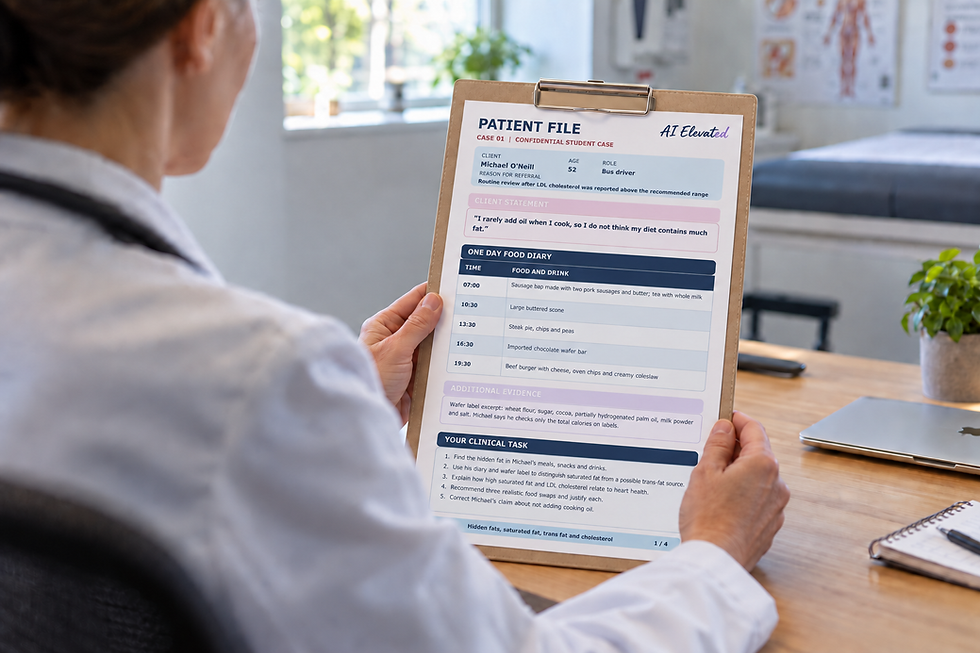
I uploaded the relevant section of the CCEA specification and my fat topic notes to ChatGPT. I asked it to create eight fictional patient files with different diets, ages and lifestyles, using a doctor’s clipboard layout. Each file includes a short profile, a one-day food diary, an additional clue or comment from the patient, and questions for students to investigate. I also asked for separate teacher answer sheets.
The first set gave me useful variety. One patient’s diary included several foods containing saturated fat, although the patient did not recognise where it was coming from. Another vegetarian patient’s meals contained sources of omega-6 but very few obvious omega-3 sources. A patient using coconut products believed that anything natural and plant-based must be the healthier choice. Ben, a teenage rugby player, had gone in the other direction: his one-day diary showed very few obvious sources of fat.
The later files took the life-stage questions into pregnancy, infancy and breastfeeding. I was pleased that the diets and circumstances were not simply eight versions of the same problem. The patients also varied in gender and ethnicity, without those details being used as shortcuts to assumptions about their diets.
The idea was to invite students to step into a dietitian’s role for a classroom exercise: examine the information, suggest appropriate dietary changes and explain the nutritional reasoning behind them.
The part I had to repair
The first version gave every patient essentially the same questions. It asked students to identify foods high in fat and classify the predominant type of fat, even in Ben’s file, where the point was that his diary showed very little fat. That question did not make sense for the evidence in front of them.
I prompted ChatGPT to tailor the questions to each patient. Ben’s task now asks students to identify what appears to be missing, explain why a very low-fat pattern may be unsuitable for a growing teenager who trains, and suggest realistic additions. The pregnancy file asks students to distinguish between different dietary precautions. The breastfeeding file asks them to explain a milk swap in the context of that patient’s diet rather than recite a generic function of fat.
The infant file also needed particular care. Advice about milk and fat depends on the child’s age and stage, so that detail must be clear in the case and reflected in the answer sheet.
The clipboard presentation made the resource appealing, but the questions and answers had to follow the evidence. Checking the food diaries, answer sheets and health explanations against my teaching sources and relevant guidance is an essential part of preparing the files for classroom use.

How I plan to use the patient files with the class
I have not used the patient files with the class yet. I plan to use them in an upcoming lesson this week, with students working in pairs. Each pair will examine a file, use the food diary to support its answers and present its reasoning to the class. I want them to say more than “eat less fat” or “choose healthy fats”. I want to hear a chain of reasoning:
Food evidence → type or role of fat → effect in this person’s circumstances → justified advice
The presentations should also let the class compare cases. Advice that may be sensible for someone trying to reduce saturated fat cannot simply be copied into an infant’s file. I will be listening for whether students can explain LDL and HDL accurately, use cardiovascular terminology where appropriate and make their life-stage answers specific.
A one-day food diary also has limitations. Students can discuss the evidence it provides, but they should not assume that it represents everything the fictional patient usually eats. That distinction offers another opportunity to ask what further information they would need before reaching a conclusion.
I cannot yet say whether the files have improved students’ application; that is what the lesson will help me find out.
A prompt to adapt
If you teach another nutrition topic, you could use the same approach for protein, carbohydrate, vitamins or minerals. Upload the relevant section of the specification, notes and any relevant examiner feedback first. Here is a version of the prompt you can adapt:
Create eight fictional patient files for my students on [topic and course level]. Use the attached specification, notes and examiner feedback as the main sources.
Give the patients varied ages, life stages, diets and circumstances, with one clear teaching focus for each case.
For every patient, include a short profile, a realistic one-day food diary, one additional clue or mistaken claim, and questions written specifically for that person’s evidence. Do not repeat a generic question if it does not fit the case.
Make students identify relevant foods or gaps, apply the science, explain likely effects and justify realistic advice. Include a question about what further information would be useful where the diary alone does not support a firm conclusion.
Produce separate teacher answer sheets with acceptable responses and misconceptions to watch for. Specify an infant’s age where it affects the advice. Flag health claims that require checking against current guidance and avoid presenting a fictional case as a diagnosis.
Show me the text for checking before making printable files in a clipboard style.
Four of the patient files are available in the Downloads section of the AI ElevatED website Once I have used them, I will be looking at where students’ reasoning holds together and where it stops at naming a fat. Their responses will help me assess how well they can apply their knowledge, identify misconceptions and use this evidence to inform subsequent teaching, including where further modelling or targeted practice is needed.


