
Building the Scaffold: Supporting Students to Write High-Quality Nutrition & Food Science Essays

How I used AI to turn examiner feedback into a classroom-ready essay scaffold

As my students began their A-level Nutrition and Food Science course, I wanted them to complete a 12-mark past-paper question successfully and understand what a high-scoring response required. I was conscious that they were making the step up from GCSE-style questions to an AS extended response that required them to bring several skills together at once.
They had to remember the relevant nutritional elements, analyse what each protein source provided, compare the two sources point by point and evaluate the impact of each on health. They also had to use comparative language throughout their response.
Phew! That is a lot packed into one question.
I wanted a scaffold that brought all these demands together. It needed to remind students of the nutritional areas they might discuss, guide them to examine both protein sources point by point and prompt them to connect each nutritional fact to its possible effect on health. At the same time, it had to encourage genuine comparison rather than two separate descriptions.
Although this example comes from CCEA GCE AS Nutrition and Food Science, the underlying challenge will be familiar to teachers across many subjects. Extended questions often require students to recall, select, analyse, compare and evaluate information at the same time.
I used examiner feedback, assessment materials and ChatGPT to turn that complex thinking process into a visible classroom scaffold and a supporting writing toolkit.
What the examiner feedback revealed
In the CCEA AS1 Principles of Nutrition examination, students answer two 12-mark extended-writing questions. These are assessed holistically, so students do not simply collect one mark for each correct fact. The mark band reflects the overall quality of their knowledge, application, analysis, organisation and written communication.
One recurring issue identified in examiner feedback is the way students approach compare-and-contrast questions.
When asked to compare the nutritional value and health benefits of two protein sources, weaker responses may describe everything the student knows about the first food before moving on to the second. The student has written about both foods, but has not actually compared them.
For example:
Fish contains high biological value protein, omega-3 fatty acids and vitamin D. Pulses contain low biological value protein, fibre and iron.
These facts may be relevant, but the comparison is left for the examiner to infer.
A stronger response compares the two foods concurrently:
Fish provides high biological value (HBV) protein containing all the indispensable amino acids, whereas pulses are generally low biological value (LBV) protein sources. However, pulses can be combined with cereals through protein complementation to improve the amino acid balance of the meal for vegetarian diets.
The second version makes the relationship between the foods explicit and opens the way for the student to explain why the difference matters.
I was also aware that my students might:
focus on nutritional content but forget the health benefits;
use few comparative terms, such as whereas, both, however and in contrast;
make vague claims such as “it is healthy” or “it is good for the heart”;
recall facts without applying them to the foods named in the question.
Using ChatGPT to design the scaffold
I created a dedicated ChatGPT Project and used relevant content from the CCEA specification, comments from examiner reports, selected points from mark schemes and my own PowerPoint as source material. I focused on the material directly related to compare-and-contrast questions about protein sources and the requirements of the 12-mark response.
I was not asking ChatGPT to produce a generic essay-writing frame using its general knowledge. I wanted the scaffold to respond to a documented problem within this particular course and examination.
My prompt was:
You are an experienced teacher and examiner in CCEA GCE AS1 Nutrition and Food Science. You are scaffolding students’ written exam answers for comparing and contrasting protein sources in relation to nutritional value and health benefits, for example the 2019 question comparing fish and pulses and the 2026 question comparing Quorn and red meat. Design a template that students can complete as they attempt each of these questions.
Asking ChatGPT to adopt the role of an examiner did not make it an examiner. The authority still came from the CCEA documents, and professional judgement was needed to check, refine and present the output appropriately.
What ChatGPT helped me produce
After checking and refining the content, I had two linked resources: a comparison-planning table and an AS1 Section B writing toolkit.
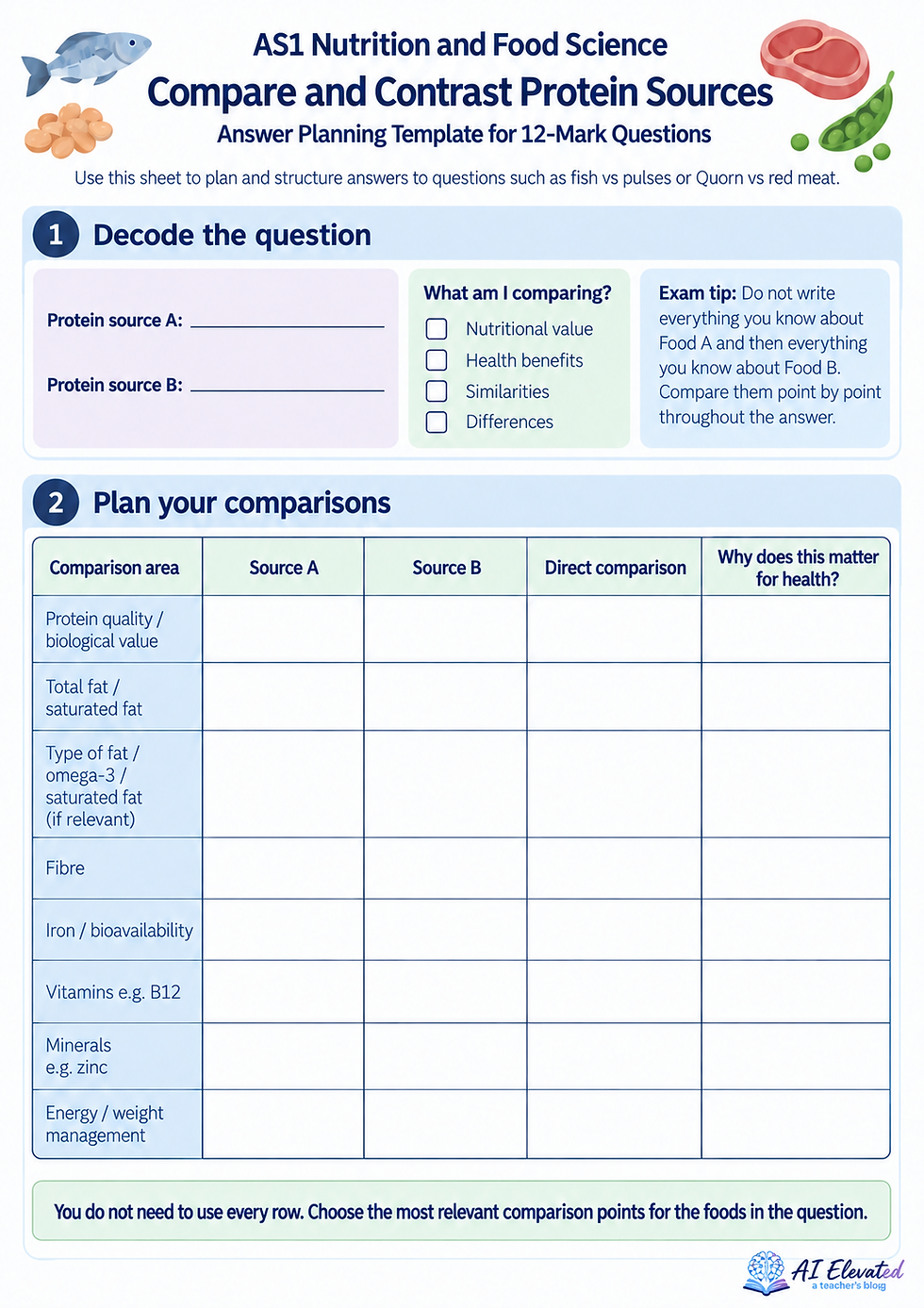
The comparison-planning table
The table asked students to work across five columns:
comparison area;
protein source A;
protein source B;
direct comparison;
why this matters for health.
The first column suggested relevant nutritional areas, including protein quality, biological value, fat, fibre, iron and its bioavailability, vitamins, minerals and energy value.
The structure helped students follow a clear sequence:
Nutrient fact → Direct comparison → Health significance
For example, stating that pulses provide non-starch polysaccharide is a relevant nutritional fact, but it does not explain the health benefit. A developed point would explain that non-starch polysaccharide increases faecal bulk, supports peristalsis and may help to prevent constipation.
Similarly, “good for the heart” is too vague. A student could explain that replacing some saturated fat with unsaturated fat may help to reduce blood LDL cholesterol and therefore reduce the risk of coronary heart disease.
The Section B writing toolkit
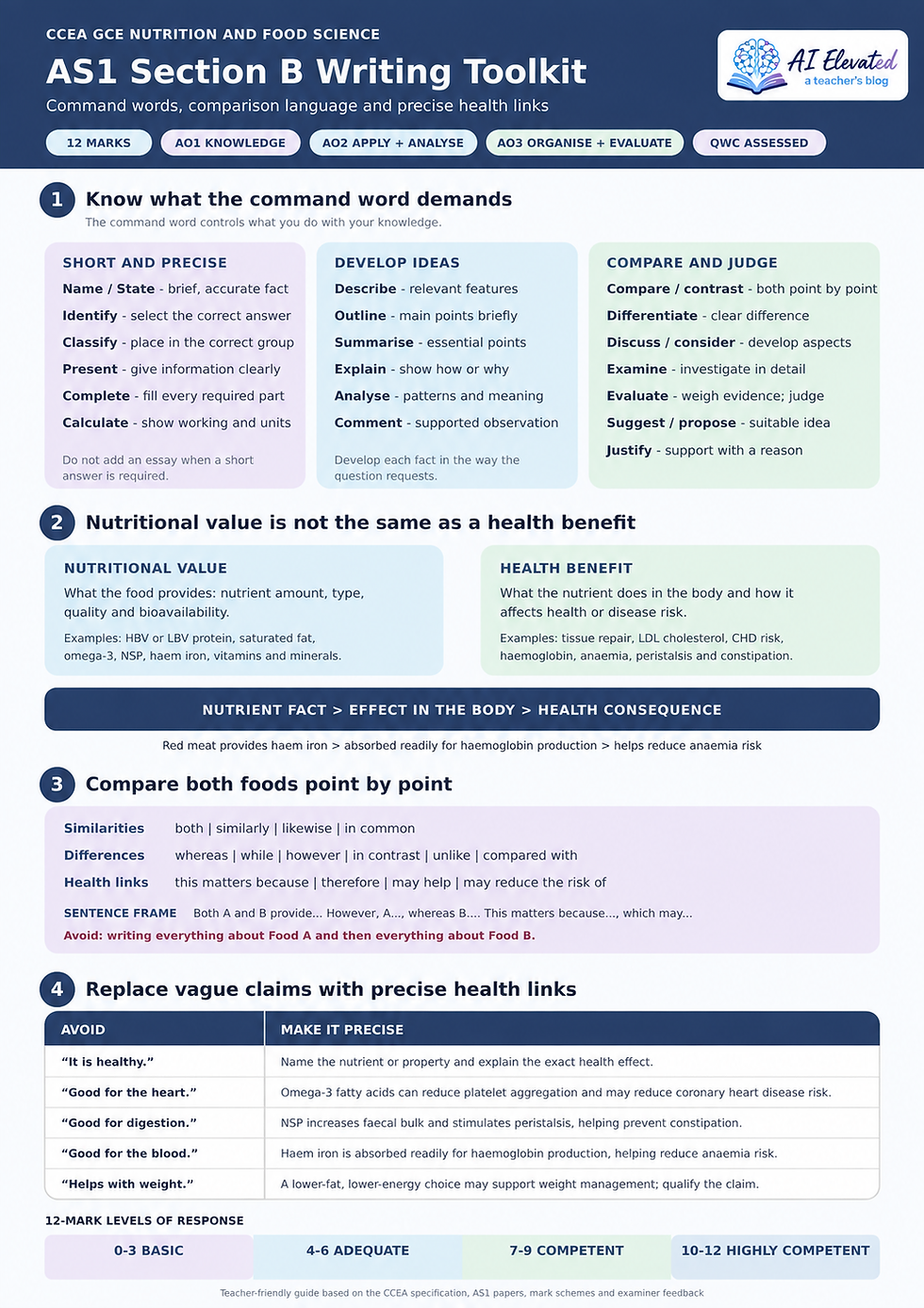
I also generated a one-page writing toolkit designed to sit alongside the planning table. It brought together several aspects of extended-response writing that students needed to remember:
what different command words require them to do;
the distinction between nutritional value and a health benefit;
comparative vocabulary and a sentence frame;
examples of how to replace vague claims with precise health explanations;
the examiner feedback about comparing both foods point by point rather than discussing each separately;
the levels of response for a 12-mark question.
The distinction between nutritional value and health benefit was particularly important. Nutritional value refers to what a food provides, while the health benefit explains what that nutrient does in the body or how it may affect health.
The toolkit reinforced a second useful sequence:
Nutrient fact → Effect in the body → Health consequence
The planning table provided the structure for the answer, while the toolkit acted as a quick reference for the language, precision and level of development required.
How I used the scaffold in class
The students used the planning table to practice two past paper questions:
comparing and contrasting the nutritional value and health benefits of Quorn and red meat;
comparing the nutritional value and health benefits of fish and pulses.
I modelled how to work across each row. For every comparison area, students recorded the relevant information for both foods, connected it using comparative language and explained why the similarity or difference mattered for health.
Once the table was complete, they used it to plan their extended response. Each paragraph had to keep both foods in view rather than presenting a complete evaluation of one food followed by a separate evaluation of the other.
In the resulting essays, I could see comparative terms such as whereas, while, both, however, unlike and in contrast appearing throughout. The comparisons were explicit rather than left for the examiner to infer.
The scaffold did not write the answers. Students still had to recall the knowledge, decide which points applied, make the comparisons, explain the health significance and construct the final response.
An unexpected formative-assessment tool
The planning table also gave me something I had not initially prioritised: a quick diagnostic overview of student knowledge.
By scanning the completed tables, I could see where detail was missing before reading every full essay. Blank, weak or inaccurate cells revealed which areas needed to be revisited in the next lesson.
Some of this knowledge should have transferred from GCSE, particularly students’ understanding of macronutrients, micronutrients and their effects on health. The table showed where that prior knowledge had not been retained or was not being applied at AS level.
It also exposed several misconceptions:
“Quorn cannot be an HBV protein because it is a novel protein source.”
Quorn mycoprotein is classed as HBV because it provides all the indispensable amino acids. “Novel” describes the type or origin of the protein, not its biological value.
“Red meat is high in energy.”
This is too broad. Its energy and fat content depend on the cut, the amount of visible fat and the cooking method.
“Vitamin B12 provides energy.”
Vitamin B12 is needed for normal energy-yielding metabolism, but it does not provide energy itself. Energy is supplied by carbohydrate, fat and protein.
Other errors included stating that calcium enhances iron absorption, rather than vitamin C, and describing Quorn generally as “high in unsaturated fat” when its nutritional composition varies between products.
The completed tables therefore acted as an essay plan, a retrieval task, a misconception check and a guide for responsive teaching.
This was a classroom trial rather than a formal comparison of marks, so my evidence at this stage is observational. However, I could see that students were making more explicit comparisons, while their planning revealed the gaps I needed to address next.
Fading the scaffold
A scaffold should be temporary. Its purpose is to support students while they learn a process, not to become something they cannot work without.
The first version provides the comparison areas in the left-hand column. When students next answer this type of question, I plan to remove that content and ask them to identify the relevant areas themselves.
I can then reduce the prompts further until students are able to reproduce the structure independently in a brief exam plan:
Comparison area → Both foods → Direct comparison → Why it matters
Eventually, they should no longer need the table or writing toolkit.
I have also adapted the structure for questions asking students to compare protein sources in relation to cost, versatility, preparation and storage. In that version, the health prompts can be replaced with areas such as price, availability, range of uses, preparation requirements and suitability for different meals. The content changes, but the thinking process remains the same.
Adapting the idea for another subject
The same approach could be used whenever examiner feedback identifies a recurring weakness in how students structure or apply their knowledge.
A scaffold or writing toolkit might help students compare interpretations in History, connect causes and effects in Geography, analyse experimental findings in Science or compare writers’ methods in English.
A generic version of the prompt could be:
Using relevant content from the specification, examiner reports and selected mark-scheme points, identify the thinking students need to demonstrate when answering [QUESTION TYPE]. Design a temporary classroom scaffold that makes this thinking visible without writing the answer for them. Include prompts for [RELEVANT ASSESSMENT SKILLS] and suggest how the support could be gradually removed as students become more independent.
The layout will depend on the subject and question, but the principle is transferable: identify the thinking students find difficult and provide temporary support that makes it visible.
Would I use it again?
Yes. The most valuable outcome was not simply that ChatGPT produced a table and writing toolkit. It helped me translate several sources of assessment evidence into practical classroom resources.
Both resources were rooted in the specification and examiner feedback, checked using my subject knowledge and designed for a real classroom need. The planning table helped students turn two separate collections of facts into a genuine point-by-point comparison. The writing toolkit brought the command words, comparative language and required precision together in one place.
The completed tables help me identify what students understand, what they had forgotten and which misconceptions I need to address next. That combination of student support and teacher insight is why I will use and adapt these resources again.


